No, I don't mean marketing--as in MAD MEN marketing.
I mean...going to the market!
Rick and I both LOVE markets---prefer them to almost anything else. The colors! The smells (+/-)! the exotic fruits and veggies!
So when I first came here as a tourist and saw the Centenary Market in central Thimphu, I said to myself:
I could live in Bhutan! And now here I am, going to this market every week.
All villages and towns in Bhutan have an open air market---with locals selling local produce, grains and home made alcohol (usually attractively packaged in old plastic coke bottles). Thimphu's market is the biggest--a two story, open sided concrete building, with electric lights!


Fiddlehead ferns from the river banks, now at the end of their
season so looking a bit bedraggled here!




Squash slices--type? anyones guess!


"Incongruities" is a kind phrase!
 And this is the hard variety---and I mean HARD. Bhutanese put a square in their mouth and chew it all day. It's a dentist's nightmare. Any one of these could be used as a doorstop.


I mean...going to the market!
Rick and I both LOVE markets---prefer them to almost anything else. The colors! The smells (+/-)! the exotic fruits and veggies!
So when I first came here as a tourist and saw the Centenary Market in central Thimphu, I said to myself:
I could live in Bhutan! And now here I am, going to this market every week.
All villages and towns in Bhutan have an open air market---with locals selling local produce, grains and home made alcohol (usually attractively packaged in old plastic coke bottles). Thimphu's market is the biggest--a two story, open sided concrete building, with electric lights!
There is the GRAIN section:
These are piles of different types of rice. Ever tried Bhutanese RED rice? YUMMY!
And then all these weird sort of puffed things, which are dyed in bright colors, have no nutritional value, but show up at every party you go to.
SPICES: yes, that is red chili powder, put in almost every dish, even at breakfast. Ohhh, my poor stomach! Bhutan is a great place for chili eating New Mexicans!
Not really sure what all these spices are...some of them are incense to burn in your home altar.
Or, if you prefer your incense in stick form, that's available, too! All of it handmade and local.
The vegetables and fruits you get all depend on the season. Just to give you a taste:
Lots of chilis---no jalapenos, though. Many of them are hotter than jalapenos.
Sugar cane from southern tropical Bhutan.
Fiddlehead ferns from the river banks, now at the end of their
season so looking a bit bedraggled here!

Here's Rick buying carrots. Note the Bhutanese woman breastfeeding, which is strongly encouraged here.
These are locally made brooms, made from grasses. Cheap chinese brooms with handles are also available but don't seem to be used that much!
Now, a few words about FRUITS. Did you know there are over 2000 edible fruits in the world and the west eats only about 10% of them?
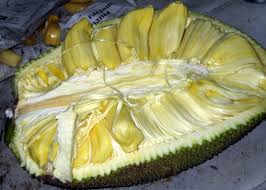
This may be a new one for you: the JACK FRUIT:
Yes, I know it looks like a tumor. Here's what it looks like in the inside.
Personally, I think it's too much trouble to prepare and eat.
Here's a picture of the one of dozens of fruit stalls at the Thimphu market:
Our favorite fruit seller:
Fortunately for us, Bhutan does not grow DURIAN. Have you tried it? If not, I invite you to at least try it, but be sure and hold your nose. Here is a durian fruit:
It is the most loved and most hated fruit in Asia. It is said to taste like heaven and smell like hell. Just be glad the above picture is NOT a scratch and sniff. The smell is described as garlic+ onion+ month old unwashed gym socks. In fact, in Singapore, it is illegal to bring a durian onto the subway, plane or hotel. If you can get beyond the smell, what does it taste like? Here's what I found on the Internet: When the famous British naturalist Alfred Russel Wallace tasted his first Durian in the 19th century, his comment about its taste was: "A rich, butter-like custard highly flavored with almonds, but intermingled with wafts of flavor that call to mind cream cheese, onion sauce, brown sherry and other incongruities.
But back to Bhutan:
CHEESE: Let's face it, Asia is just not the place to be if you like cheese.
It's not that Bhutan doesn't HAVE cheese...it's just, well, mostly fermented yak cheese. There are three varieties:
Here is the soft hockey puck shaped cheese, used in their national dish, ema datsi (chilis and cheese).
Now, let's talk about DOMA. This one is hard to describe, but the closest thing I could relate it to is chewing tobacco--only it stains your tongue, teeth and spit a bright red color. It is definitely a culturally acquired taste, as most Bhutanese love it and it makes most chillips(foreigners) throw up. It consists of an areca nut, wrapped in a betel leaf with a dash of lime paste. You put it between your gum and teeth, and then just let it sit there, chewing it on occasion. It is called "a conversation starter" and Bhutanese of all ages and genders love it, especially after a sumptuous dinner. It is a traditional offering on all occasions. First mention of doma in literature is from 1637! Thankfully (in my opinion) the younger generation is not so into this, as they dislike the red spit, just as I do. Still, I know many very sophisticated and educated Bhutanese who can't resist. Old people tell me it keeps them warm in winter. Doma is so embedded in Bhutanese religious and temporal spheres that it is indispensable to the culture.
So, of course, you can buy it at the market!
The leaf:
The nut:
Here it is in action----
Despite what you/I may think, any Bhutanese would tell you that doma contributes to Gross National Happiness!
There is only one part of the market that I absolutely avoid. But in my quest to show it all to you, I did go to the dried fish section. I was there just long enough to snap this picture:
Don't even ask.....
And finally, my favorite part--the flowering plants, not to be eaten, but certainly to be admired!
If you want to see more of this amazing market, check out this 11 minute utube, done by some Brit tourist. At around 9 minutes, he covers the handicraft market which is just across the bridge from the Centenary Market. It is colorful indeed!
Rick just arrived home from work. Soon he will start on dinner made from the fresh veggies we just bought yesterday at this market. In the meantime, it continues to rain, and the laundry put out to dry this morning is nowhere near dry---ahh, the problems of the developing world!
Wishing you love and good food!
Phyllis


